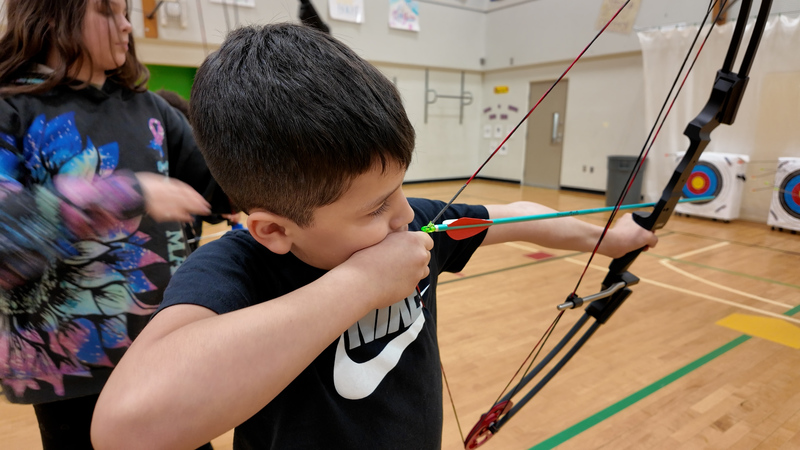
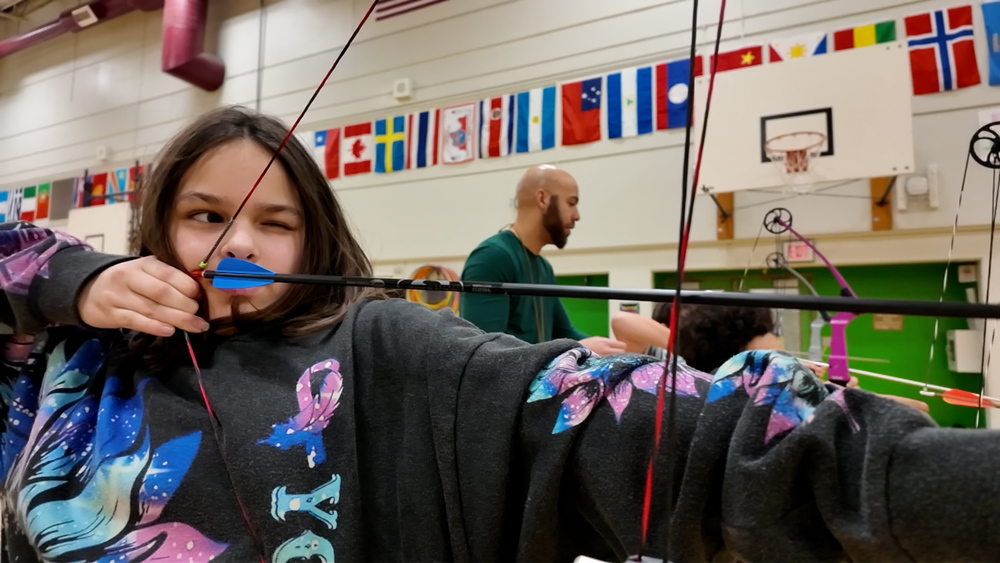
When you think about an archery club at an elementary school, you might envision toy bows and arrows.
Fourth grade teacher and Archery Club advisor Sean Mills explained why this isn’t the case for participants in the National Archery in Schools Program (NASP), like what he’s running at Frances Scott Elementary.
“They are non-bladed, pointed, aluminum shaft arrows," he said.
“It is a great way to get kids into bows and archery in a safe way. Believe it or not, the NASP program with this equipment taught this way is actually the second safest, P.E. activity that we do in the nation because it's designed to keep the dangerous bits away from the kids when it's in somebody's hands."
In fact, according to the NASP, Archery is safer than every gym sport taught in North America except table tennis.
Before visitors to Mills’ club hear any thumps of arrows hitting targets, they’ll first hear detailed directions, followed by whistles. All designed to underscore safety.
"The whistle commands put kids where they should be and when they should be there,” he explained. “That way, in theory and in practice, nobody has a bow in their hand while somebody is in front of them."
If a student drops an arrow that rolls past the firing line, Mills makes it clear that they should leave that there until no one has a bow in their hand.
He didn’t let students pick up a bow on the first day of the club, either.
"[NASP rules] actually require we do ten hours of curriculum time teaching those rules and these safety precautions before we can even get the club,” he said. “So we did that in cooperation with our PE teacher, Ms. Conklin. Ten hours for all the fourth and fifth graders, and then anybody who wanted to pursue it any further, they got to come and sign up and be part of club."
As Spokane Public Schools looks to get every kid off screens and interacting with other kids outside of the school day, Mills emphasized the value of expanding activity options.
"When I grew up, you know, you have your major sports in schools -They didn't interest me,” he said. “So, you know going home reading a book or just getting on video games, that kind of stuff. I did that a lot.”
That lack of opportunity limited his connection with community, something Mills sees in students today. He said clubs like this show kids the possibilities.
“There are a lot of things that I thought I couldn't do just because the opportunity wasn't put in front of me,” he said. “So, putting these even outside the box clubs in front of kids, I think, is really important because it just opens up the world that much more."
Getting the program off the ground wasn't easy, but Mills says the challenge taught him something about himself.
”Every day, there's more stuff that I realize I can do. And this club is an example of that,” he shared. “It seemed kind of like a lot at first to write the grant, to go to the training, to get it passed with the district, but one thing at a time got it done.”
His message for other students and teachers?
“If you can think it, go for it,” he said, smiling. “I mean, the worst they can do is say no."