
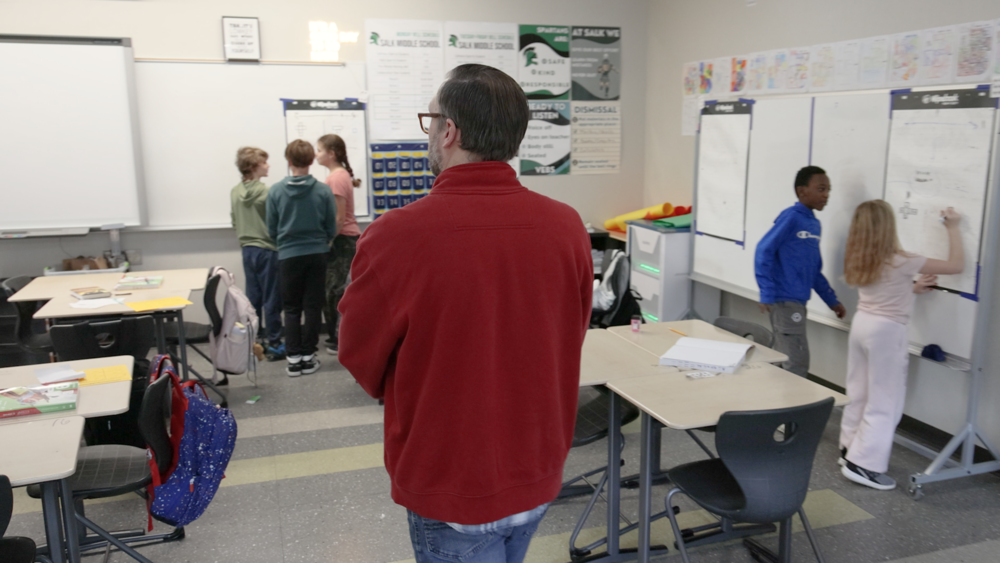
Finding ways to keep math engaging, let alone fun, is a problem teachers are always looking to solve. Some Spokane Public Schools teachers have started using the "Building Thinking Classrooms" method by Peter Liljedahl.
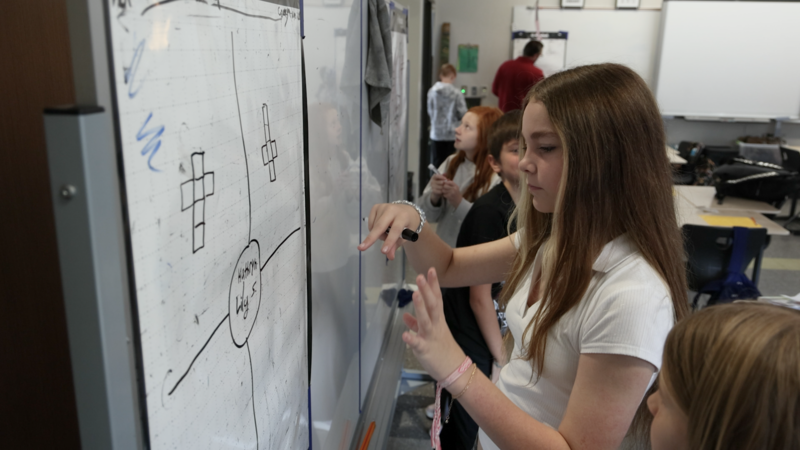
Instead of rows of desks facing the front, these classrooms get students on their feet in small groups around whiteboards, talking, sketching, erasing, and trying again.
It Started with a Podcast
Ryan Foley is in his 18th year of teaching and his 12th with SPS. He now teaches 6th grade math at Sacajawea Middle School. In 2019, he came across an episode of the podcast Making Math Moments That Matter featuring Dr. Liljedahl.
"I knew after the episode, his approach to teaching was something I certainly desired," Foley said. "I also knew if I had continued with my traditional approach, it would be in defiance of a teaching I knew was better."
So, he started with a course on teaching through tasks and problem solving. In Foley's words, that meant "really flipping the gradual release, 'I do, we do, you do' approach to teaching on its head."
Foley passed the idea along to Michael Anderson, a 6th grade math teacher at Salk Middle School who is in his 22nd year of teaching. The two were hired by SPS at the same time. “He’s kind of like my doppelganger on the other side of the river," Anderson laughed. "He said, hey, you’ve got to check this out. ‘Building Thinking Classrooms.’ And so we did a book study and there were three of us, and he and I kind of stuck with it."
What It Looks Like in Action
Anderson says the method rests on a few key pieces:
De-front the classroom. There's still a front of the room, but the teacher isn't the "sage on the stage."
Get kids up on whiteboards. "Some of our best thinking can be done standing up," Anderson said. The whiteboards are also "a safe place to make mistakes," because students can erase and try again.
Use random groups. Students wind up working with classmates they might not normally pick, which builds communication.
Give thinking tasks. These are problems where the students do the initial thinking, instead of following a teacher's steps.
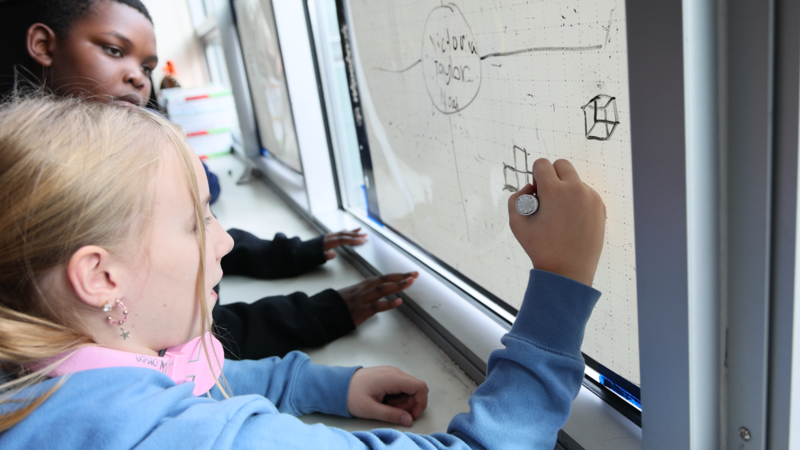
On the day we visited, Anderson's 6th graders were starting a unit on polyhedra. He hooked them with Dungeons and Dragons dice, then gave them a challenge: how many ways can you unfold a cube into a flat shape?
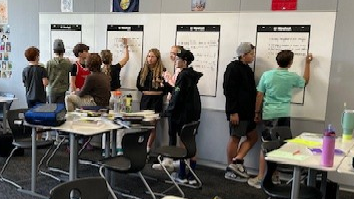
Each student received a playing card, which decided their random group. Students gathered in small groups at white boards labeled ace through ten. The group is given a single marker to share.
"The student who's writing is not allowed to write their own ideas," Anderson explained. "If they do, they have to pass the marker off to someone else and tell them how to draw it and what to draw."
The goal behind this approach is that kids are owning their thinking, rather than being walked through it by a teacher.
Why these Teachers Love It
Ask Foley and Anderson why it works, and the same word keeps coming up: conversation.
"The students are their best teachers. Their ability to problem-solve in unique ways, and how their ideas organically spread through the class cannot be replicated in a traditional teaching model,” Foley said, adding that it also changed how he sees his own role. "I used to think I was the purveyor of knowledge, the dispenser of how to solve problems... I was wrong."
Anderson sees that face-to-face connection as something today's students really need.
"That communication piece face to face, I think, is missing when we're on our phones texting each other," he said. "Some of our best work and best groups are with people that probably wouldn't ever hang out outside of the classroom."
The method isn't just for middle schoolers. Mrs. Casey Kuehn, who teaches math at Lewis and Clark High School and has spent all 20 years of her career in SPS, heard about it from a colleague, then read the book. Her favorite part is watching students figure things out for themselves.
"Seeing students discover how/find new ways to solve problems - it's so much more meaningful than being told step-by-step from their teacher,” she said. “They remember it better, too."
In her view, the method is good for all ages as a way to keep thinking alive and vibrant.
"In this world of AI doing so many things for us, BTC brings back the importance of personal connection- collaborating, questioning, persevering, critiquing, and working together for a common goal," she said.