Anyone who’s purchased groceries in the past month knows the challenge of adjusting a budget to absorb higher prices on household items, like breakfast cereal and disinfecting wipes.
That process gets a lot more complex when you’re buying those items for 58 schools.
In public districts like Spokane Public Schools, these expenses are referred to as Materials, Supplies, and Operating Costs, or MSOC. Along with food and cleaning products, they also include utilities, insurance, classroom supplies, and other day-to-day essentials that keep schools running.
While the Washington Legislature provides school districts with an MSOC allocation, this funding isn’t keeping pace with inflation and rising operating costs. At the same time, the state has shifted its priorities and the share of the total state budget allocated to K-12 education fell to 42.2% this year — the lowest level since 2011.
Tracking the costs
To illustrate the financial pressures on school districts, we reviewed operating costs at four representative SPS schools over the past five years. We specifically looked at water, sewer, heat, and electricity utilities as well as phone and internet systems. At the elementary level, costs increased by 25–34%, while high school costs rose by an average of 39–47% (see Fig. 1). 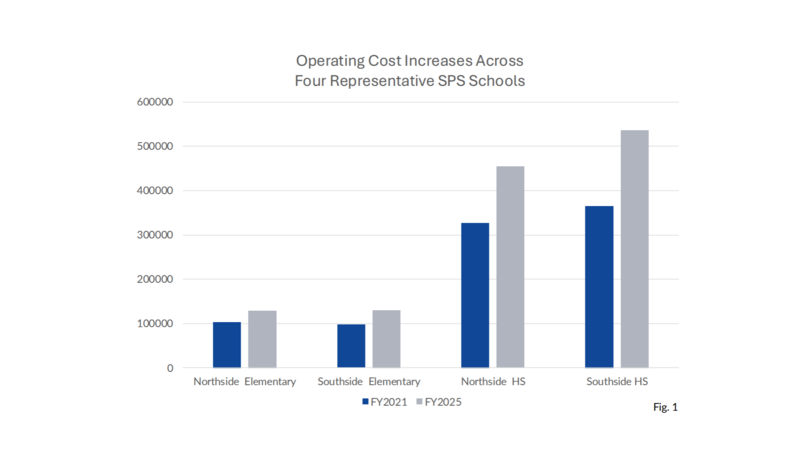
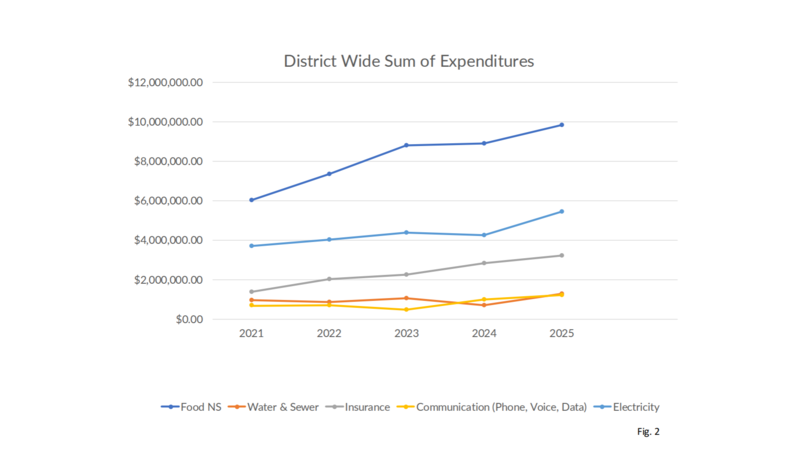
This budget pressure becomes even clearer in a comparison of district-wide costs from 2021 to 2025 (Fig. 2):
Operating costs rose from about $14.7 million to $24.0 million.
Insurance rates more than doubled, increasing from about $1.4 million to $3.2 million.
Electricity rose from $3.7 million to $5.5 million.
Solid waste collection went from about $810,000 to $1.3 million.
Food costs rose from roughly $6 million to $9.8 million.
An item-by-item review shows hundreds of things cost more than they did five years ago, including custodial supplies (36% increase), cleaning detergents (22%), frozen food (41%), meat (29-50%), and many types of paper (27-93%).
MSOCs aren’t extras. Schools have to keep the lights on, heat buildings, insure facilities, feed students, and stock classrooms and restrooms so students can learn and teachers can educate without distraction.
A proactive response
SPS superintendent Adam Swinyard captured this reality in a March press conference.
“We’re making sure that we’re running our school district as cost efficiently as we possibly can because we’re dealing with historic inflation,” he said. “Diesel costs more, chicken nuggets cost more, crayons are wildly expensive. I told the elementary staff today, ’No more eating of the crayons. Tell the children to stop. They’re way too expensive.’ And of course, there’s humor there, but the reality of inflation is that it’s a huge challenge.”
SPS has been taking proactive steps to meet this challenge for the past several years, cutting as much as $5 million in spending per year through staff attrition, retirements and other cost saving measures.
The district is also finding operational efficiencies, such as bringing student transportation in-house beginning in the 2027-28 school year.
“It will be more cost efficient for us to have an in-house transportation system,” Dr. Swinyard explained, describing the plan as a unique creative pathway that will have a generational impact.
The SPS capital projects team is meanwhile considering inflation’s impact on construction projects funded by Together Spokane, sequencing projects to build as much as possible sooner than later.
“There’s huge intentionality in those decisions, because we're trying to address inflation and be really thoughtful to get the highest value for every dollar that we can,” Dr. Swinyard said. “Every day that goes by, the cost escalates.”
Just like a household bank account, balancing the district budget requires making careful, often difficult decisions in an environment where many of the fastest-growing costs are outside our control.
SPS is committed to Financial Transparency in explaining the budgeting process with our community. We also update our Financial Information with current and previous school year budgets, interim financial reports, annual comprehensive financial reports, and state auditor reports as available.