
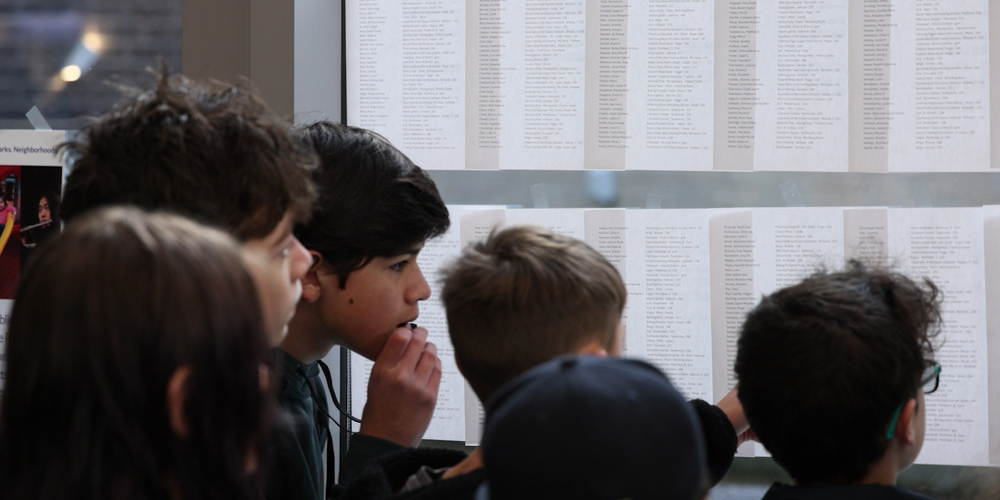
Three days a week, every week of the school year, Glover Middle School students arrive at school and head straight to Falcon Time. Held during the school’s Advisory period – those over the age of 30 might have called it Homeroom – the session allows students to participate in an activity specific to their learning needs or interests.
“It really came out of an overall dissatisfaction of how we responded as a building to when kids don't learn,” explained Principal Mike Stark. “What do we do with kids who don't learn a standard that they're going to need to be either successful in life or successful next year?”
That was four years ago. That’s when the Glover team set out to find solutions.
They had to focus their efforts to most effectively use the 66 minutes they had each week, knowing that it was not enough time to address every standard in every subject.
They pinpointed math and English Language Arts (ELA), knowing that success in those subjects would translate to success in social studies, science, and elective subjects.
Administration and staff developed quick formative assessments that teachers would give in class at the end of each 2-week learning cycle to see if students were meeting standards. During weekly Late Start Monday Collaboration, teachers evaluate results to determine which students are ready to move on and which kids need a little extra time and support – intervention – to successfully learn and apply these skills.
Students who aren’t demonstrating competency with a learning standard are assigned to an intervention small group during Falcon time. They’ll often be paired with an instructor who isn’t their regular teacher as that different presentation may help a subject “click” with the student.
“It gives the kids lots of variety. It gives them lots of access to teachers that they otherwise wouldn't have the chance to get to know,” Stark said.
Students who are meeting standards are assigned to a 2-week session of an enrichment activity based on their response to an interest survey. Activities cover quite a range – crafting, chess, volleyball, karaoke, weight training, cooking, and welding among them.
“The idea of getting to pick an enrichment is very motivating for kids who may not have been motivated before,” Stark said. “You know, those kids who can do it but don’t put forth the effort on an assessment. Now we have kids who are trying super hard in class to get to select a cool enrichment activity.”
These activities are often connected to other curriculums, like the arts, physical fitness, and Career & Technical Education (CTE). They can explore these programs and begin to think if these are subjects and activities they’d like to pursue in future semesters or high school, and even consider how they could translate to future careers.
Falcon Time in its current structure is going strong. The two-week schedule and school-wide participation has also helped students see intervention as an opportunity to learn, rather than a punishment or a reflection of intelligence.
“We don't have kids complaining about being in intervention anymore,” Stark said. “They understand this is something that is so important that if you don't know how to do this, it's going to impact you in life. It's going to impact you in high school. We have some kids that request intervention every single week. It's made a huge difference in their performance.”